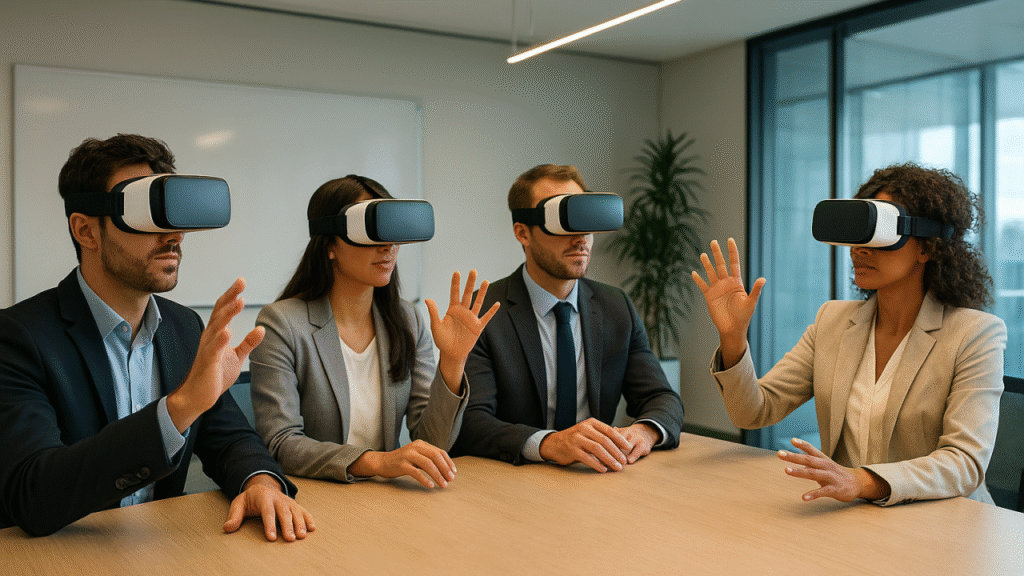
Let’s be honest, traditional corporate training in India hasn’t changed much in decades. We still have employees sitting through long classroom sessions, flipping through PowerPoint slides, and trying to stay awake during a two-hour compliance module. And at the end of it all? Most of them forget 70% of what they learned within a week.
In 2026, that’s just not good enough anymore.
Indian businesses are scaling faster than ever. The competition is intense, the talent pool is demanding, and the margin for on-the-job errors, especially in industries like manufacturing, healthcare, oil & gas, and logistics, is practically zero. This is exactly why Virtual Reality (VR) training has stopped being a “nice to have” and become a genuine business imperative.
If you’re a decision-maker wondering whether VR training is worth the investment, keep reading. By the end of this post, you’ll have a clear picture of why forward-thinking Indian companies are already making the switch and why waiting is costing you more than you think.
The Problem with Traditional Training (and Why It’s Getting Worse)
Before we dive into VR, let’s acknowledge the elephant in the room.
Traditional training methods, such as classroom sessions, e-learning modules, and PDF handbooks, were designed for a different era. They work reasonably well for theory, but they fall flat when it comes to skill-based learning, hazardous situation preparedness, and hands-on practice.
Consider some common frustrations Indian HR and L&D managers face today:
- Trainers are expensive and inconsistent across locations
- Employees in remote plants or warehouses can’t easily access quality training
- High-risk training (fire safety, machine operation, emergency response) is dangerous to conduct in real environments
- New hires take weeks or months to reach full productivity
- Compliance training is ticked off on paper but rarely internalized
Sound familiar? You’re not alone. These are systemic problems, and VR training directly addresses every single one of them.
What Is VR Training, Really?
VR training uses Virtual Reality headsets and immersive 3D environments to simulate real-world scenarios for employees. Instead of watching a video about how to operate heavy machinery, an employee actually operates a virtual version of that machine with realistic controls, sounds, and consequences.
It’s the difference between reading about swimming and jumping into a pool.
Platforms like Immersive Factory, NextWorld XR, and DeftXR, available through enterprise VR solution providers in India, offer ready-to-deploy training modules across industries like manufacturing, safety, soft skills, and education.
7 Reasons VR Training Is the Smartest Investment for Indian Companies in 2026
1. Knowledge Retention Skyrockets
Studies consistently show that people retain up to 75% of information learned through immersive, experiential methods compared to just 10% from reading and 20% from audio-visual content.
When an employee lives through a simulated factory emergency in VR, their brain encodes that experience as a real memory. That’s not just theory, it’s neuroscience. And for industries where one mistake can cost a life or a crore, retention isn’t optional.
2. It Dramatically Reduces Training Costs Over Time
Yes, the upfront investment in VR hardware and software is real. But let’s look at the full picture.
A traditional safety training program for 500 employees across 3 plants might involve:
- Hiring external trainers
- Travel and accommodation costs
- Halting production for training windows
- Reprinting manuals every time a process changes
With VR training, you build it once (or deploy an off-the-shelf solution), and you can train thousands of employees repeatedly at a fraction of the recurring cost. Most organisations see ROI within 12–18 months.
3. Zero Risk, Real Learning
This is perhaps the most compelling argument for industries like oil & gas, chemicals, construction, and healthcare.
You cannot put a new safety officer through a real gas leak simulation. You cannot let a trainee surgeon practice on a live patient. But in VR? You absolutely can.
Employees get to make mistakes and learn from them in a completely safe environment. They experience the consequences of wrong decisions without any actual consequences. That kind of psychological safety is priceless for building confident, competent teams.
4. Standardised Training Across Every Location in India
India’s geography is both a strength and a challenge. Your plants might be spread across Maharashtra, Gujarat, Tamil Nadu, and Uttarakhand. Getting consistent training quality across all these locations with human trainers is a logistical nightmare.
VR training solves this completely. Whether your employee is in Mumbai or a remote facility in Jharkhand, they receive the exact same high-quality training experience. No variance. No compromise.
5. Faster Onboarding = Faster Productivity
Time-to-competency is a metric that Indian companies are finally starting to take seriously, and rightly so.
With VR, new hires can be walked through complex processes, workflows, and safety protocols in immersive simulations before they ever set foot on the actual floor. Companies using VR onboarding consistently report 30–40% faster time-to-productivity for new employees.
In high-turnover industries like manufacturing and logistics, that’s a massive competitive advantage.
6. Measurable, Data-Driven Insights
One of the most underrated benefits of VR training is the data it generates.
Every VR training session captures detailed analytics how long a trainee took to complete a task, where they hesitated, how many attempts it took, what errors they made. This gives L&D teams a level of visibility that classroom training could never provide.
You move from “we think our training is working” to “we know exactly where each employee stands and what they need next.”
7. It’s What the Workforce Expects Now
The Indian workforce is younger than ever. Gen Z employees who now make up a significant portion of the entry-level workforce have grown up with games, immersive digital experiences, and smartphones. They expect engaging, modern experiences.
Offering VR training isn’t just smart business. It’s also a talent retention and employer branding move. Companies that invest in innovative training signal to their employees: we take your development seriously.
Industries in India That Are Already Winning with VR Training
VR training isn’t sector-specific, it’s working across the board. Here’s where Indian companies are seeing the biggest impact:
Manufacturing & Heavy Industry Simulating machine operation, assembly line processes, and equipment maintenance without halting production or risking injury.
Oil, Gas & Chemicals Emergency response training, hazard identification, and SOPs for high-risk environments all conducted safely in virtual environments.
Healthcare & Pharmaceuticals Clinical procedure training, patient interaction simulations, and compliance training for medical staff.
Construction & Infrastructure Site safety training, equipment operation, and fall prevention scenarios at scale.
BFSI & Corporate Enterprises Soft skills, leadership development, customer interaction training, and compliance all delivered in immersive, engaging formats.
Education & Skill Development Vocational training institutions and universities are using VR to bridge the gap between classroom theory and industry-ready skills.
“But Is India Ready for VR Training?”
This is the question we hear most often and honestly, it’s the wrong question to ask in 2026.
The better question is: can your business afford NOT to be ready?
VR hardware has become significantly more affordable. Enterprise-grade headsets from brands like Meta, Pico, and HTC are now accessible at price points that make large-scale deployment viable. Connectivity has improved dramatically, even in Tier 2 and Tier 3 cities. And software platforms are now built specifically for Indian enterprise needs with regional language support, industry-specific modules, and local customer support.
The infrastructure is here. The technology is mature. And the early adopters are already pulling ahead.
What to Look for in a VR Training Partner in India
Choosing the right VR training partner is as important as the technology itself. Here’s what to evaluate:
- End-to-end support — from hardware procurement to software deployment and employee onboarding
- Industry-specific content libraries — pre-built modules for your sector, not just generic templates
- Scalability — can the solution grow from a pilot of 50 to a rollout of 5,000?
- Analytics and LMS integration — does it plug into your existing HR and learning systems?
- Local presence — a partner who understands Indian enterprise workflows, compliance requirements, and can offer on-ground support
Fore Excel checks all of these boxes. As a trusted VR hardware distributor and enterprise software solutions partner in India, we work with leading global platforms to help Indian businesses deploy VR training programmes that actually deliver results not just pilot projects that gather dust.
So, What’s Stopping You?
VR training is not a futuristic concept anymore. It’s a practical, ROI-driven solution that addresses real problems Indian companies face today: inconsistent training quality, high costs, safety risks, and a workforce that needs to be upskilled faster than ever before.