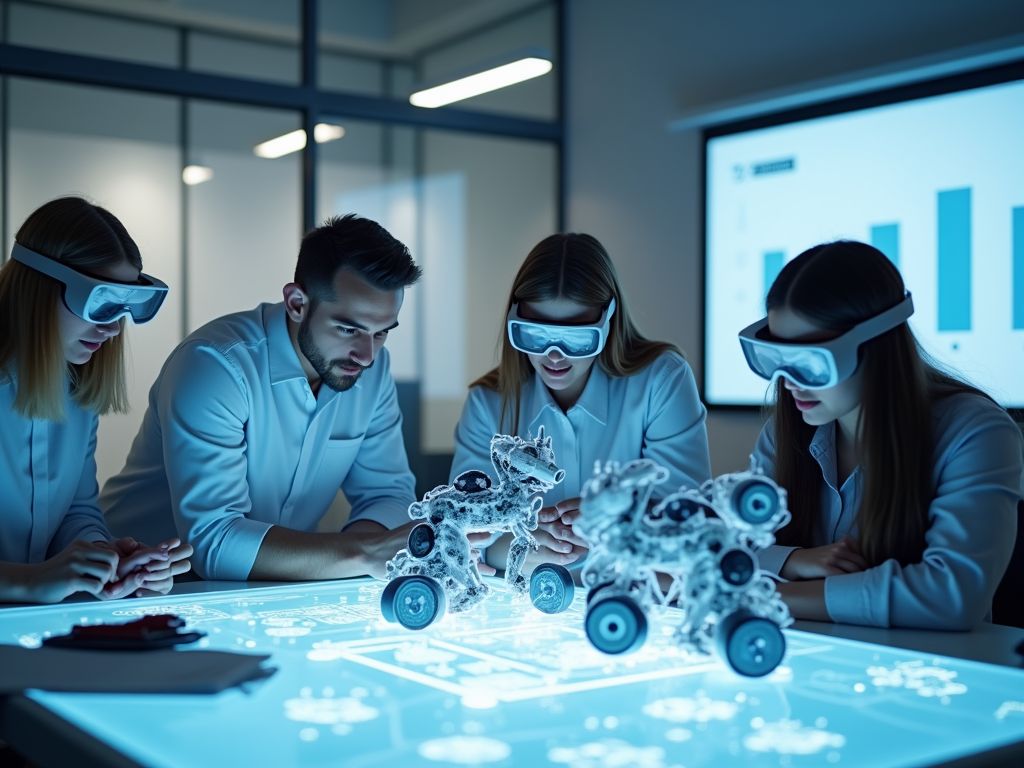
VR Training for Corporate Employees is changing how businesses in India train their teams and the results are genuinely impressive.
No more boring PowerPoint sessions. No more half-asleep employees in a training room. No more spending lakhs on trainers, travel, and venue bookings every year.
Companies across India in manufacturing, healthcare, defence, aviation, and education are switching to VR training. And once they do, they rarely go back.
So let’s break it down. Here are the top 10 benefits of VR training for corporate employees explained simply, with real examples.
What Is VR Training, Exactly?
Before we get into the benefits, let me explain quickly.
VR training means your employees wear a VR headset and learn inside a fully virtual environment. They can practise real tasks operating a machine, handling a fire emergency, and giving a sales pitch without any real-world risk.
It’s like a flight simulator. But for your entire workforce.
And with headsets like Meta Quest, HTC VIVE, and PICO XR all available through Fore Excel, setting this up for your team is easier than you think.
Now let’s get into the benefits.
1. Employees Learn by Doing — Not Just Watching
This is the biggest one.
In traditional training, employees watch and listen. In VR training, they actually do the task virtually.
Studies show that people remember 75% of what they do vs only 5% of what they hear in a lecture.
Imagine training a new factory worker on a lathe machine. Instead of showing them a video, you put them in VR and let them operate it virtually, safely, repeatedly until they get it right.
That kind of learning sticks.
2. Zero Risk, Real Practice
Some jobs are dangerous. No way around it.
A defence trainee can’t practise weapons handling in a real combat zone. A surgeon can’t practise a new procedure on a real patient. A factory worker can’t make mistakes on live machinery.
VR solves this completely.
Employees can practise in high-risk scenarios, such as fire emergencies, chemical spills, surgical procedures, and combat situations, without any real danger.
No accidents. No injuries. No damage. Just learning.
3. Training Costs Come Down Significantly
Think about what traditional training costs your company:
- Trainer fees
- Travel and accommodation
- Shutting down production for training
- Printing materials
- Renting a venue
VR training cuts most of this out.
You invest once in the headsets and the VR content. After that, you can train 10 employees or 1,000 employees; the cost barely changes.
One large manufacturing company in India saved over ₹40 lakhs a year after switching to VR-based safety training. That’s not a small number.
4. Train Anywhere, Anytime
Your team is spread across Mumbai, Pune, Delhi, and Chennai?
No problem.
With standalone VR headsets like Meta Quest or PICO XR, employees can train from anywhere. No need to fly everyone to a central training facility.
Send the headsets. Deploy the content remotely. Track progress from your dashboard. Done.
This is a game-changer for companies with large, distributed workforces.
5. Employees Are More Engaged
Be honest have you ever seen someone fall asleep during a VR session?
Probably not.
VR is immersive. When you’re inside a virtual environment, your brain treats it like a real experience. You pay attention. You react. You remember.
Employee engagement in VR training sessions is significantly higher than in classroom or video-based training. People actually enjoy it which means they show up, pay attention, and retain more.
That’s a rare combination in corporate training.
6. You Can Track Everything
This is something traditional training simply cannot do.
With VR training, you get data on everything:
- How long each employee spent on each module
- How many mistakes they made — and where
- How their performance improved over time
- Who needs more practice and who is ready
This kind of detailed analytics helps managers make smarter decisions about their teams. You’re not guessing who is trained well you actually know.
7. Consistent Training Every Single Time
When you have 10 trainers training 500 employees, everyone gets a slightly different experience. Some trainers are better. Some cover things others miss. Quality varies.
With VR, every employee gets the exact same training every time.
Same scenarios. Same instructions. Same standards. Whether it’s employee number 1 or employee number 500.
This is especially important for industries like healthcare, aviation, and defence where consistency can be the difference between safe and unsafe.
8. Faster Onboarding for New Employees
New employees take time to get comfortable. Weeks, sometimes months.
VR speeds that up dramatically.
New joinees can virtually walk through your factory floor, understand safety protocols, practise their first tasks, and get familiar with equipment all before their first real day on the job.
By the time they start working, they already feel prepared. Confidence is higher. Mistakes are fewer. Productivity starts sooner.
9. Soft Skills Training Works Better in VR
VR is not just for technical training.
Leadership, communication, conflict resolution, public speaking all of these can be trained in VR too.
Imagine a manager practising a difficult performance review conversation with a virtual employee. Or a salesperson rehearsing a pitch in front of a virtual client panel.
They can repeat it 10 times. Make mistakes in a safe space. Get better each time.
That kind of soft skills practice is very hard to replicate in a classroom.
10. It Gives Your Company a Competitive Edge
Companies that invest in modern training attract better talent.
Top professionals especially younger employees want to work at companies that take their growth seriously. VR training signals that.
It also means your workforce is better trained, more confident, and more productive than your competitors. That’s a real business advantage not just a nice-to-have.
In sectors like manufacturing, healthcare, defence, and aviation, where skill gaps are expensive, this edge matters enormously.
Which Industries in India Are Already Using VR Training?
Quite a few, actually:
Manufacturing — Machine operation, assembly line training, safety drills. Companies like Tata Motors and Mahindra are already here.
Healthcare — Surgical procedure education, emergency response, medical data visualisation.
Defence — Weapons training, terrain visualisation, tactical combat simulation.
Aviation — Pilot training simulators, ATC scenario training, crew emergency drills.
Education — Chemistry experiments, historical visualisations, complex concept demonstrations.
Automotive — Engine assembly, virtual showrooms, driving simulators.
If your industry is on this list VR training is already happening around you. The question is whether your company is part of it.
What VR Headsets Work Best for Corporate Training in India?
Here’s a quick guide based on what Fore Excel offers:
Meta Quest — Best for most companies. Standalone, easy to manage at scale, great training app support.
PICO XR — Excellent for large-scale deployment. Fore Excel is the only authorised PICO XR distributor in India — so you get genuine devices and proper support.
HTC VIVE — Best for high-precision training. Ideal for manufacturing, healthcare, and industrial simulation.
Varjo Premium choice for defence, aviation, and top-level simulation where visual quality is everything.
Not sure which one fits your team? Fore Excel will help you figure that out no pressure, just honest advice.
FAQs About VR Training for Corporate Employees
Q: Is VR training effective for all types of corporate training? Yes, both technical training (machine operation, safety drills) and soft skills training (communication, leadership) work well in VR. The immersive format improves retention across the board.
Q: How much does VR training cost for a company in India? It depends on the number of headsets and the VR content needed. The initial investment is higher than traditional training, but the long-term savings on trainer fees, travel, and downtime make it cost-effective within 12–18 months for most companies.
Q: Do employees need to be tech-savvy to use VR headsets? Not at all. Modern headsets like Meta Quest and PICO XR are very easy to use. Most employees get comfortable within 10–15 minutes of their first session.
Q: Can VR training content be customised for our company? Yes. Fore Excel offers VR training software solutions, including FotonVR, DeftXR, Immersive Factory, and NextWorld XR, that can be customised for your specific industry and use case.
Q: How many employees can be trained using VR at the same time? Multiple employees can train simultaneously using different headsets. With enterprise device management tools, you can run training sessions across 10, 50, or 100 headsets at the same time.
Q: Is VR training safe for employees? Yes. Sessions are typically 20–30 minutes long to avoid discomfort. Modern headsets are lightweight and designed for extended enterprise use.
Final Thoughts
VR training is not a luxury anymore.
It’s becoming the standard especially in industries where skills, safety, and consistency matter. The companies that invest in it now will have better-trained teams, lower training costs, and a real edge over their competition.
And the best part? Getting started is simpler than most people think.
You don’t need a huge IT setup. You don’t need to rebuild your training programme from scratch. You just need the right headsets, the right content, and the right partner.
Ready to Bring VR Training to Your Team?
Fore Excel has helped companies across India set up enterprise VR training from hardware supply to software solutions to deployment support.
We carry Meta Quest, HTC VIVE, PICO XR, and Varjo and we’ll help you pick the right one for your team size, industry, and budget.
Contact Us – https://foreexcel.com/contact/